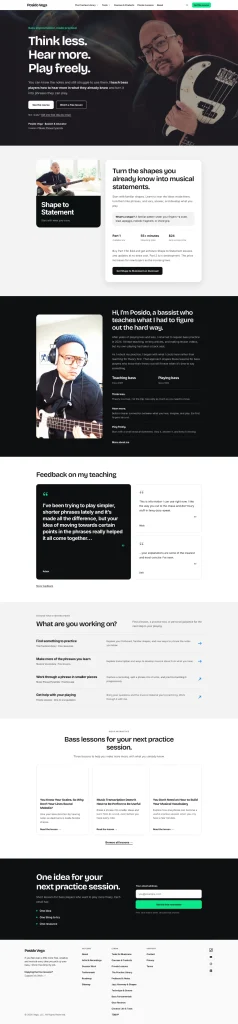
Many musicians know scales and theory but still struggle to improvise freely. Finding the next note can become a series of mental calculations that interrupts the music.
I developed a teaching approach built around simple shapes that musicians can manipulate to create melodic lines. Through posidovega.com, I turned that approach into free articles, paid courses, downloadable resources, and interactive practice tools.
The resources primarily serve intermediate bass players, while many of the concepts apply across instruments.
Project: Independent project
In use
My role: Teaching methodology, content strategy, writing, course design and instruction, video editing, resource design, SEO, and website management.
AI assistance: Article structure and SEO refinement through my Custom GPTs, along with assistance developing web tools and making technical website improvements.
Delivered at a glance
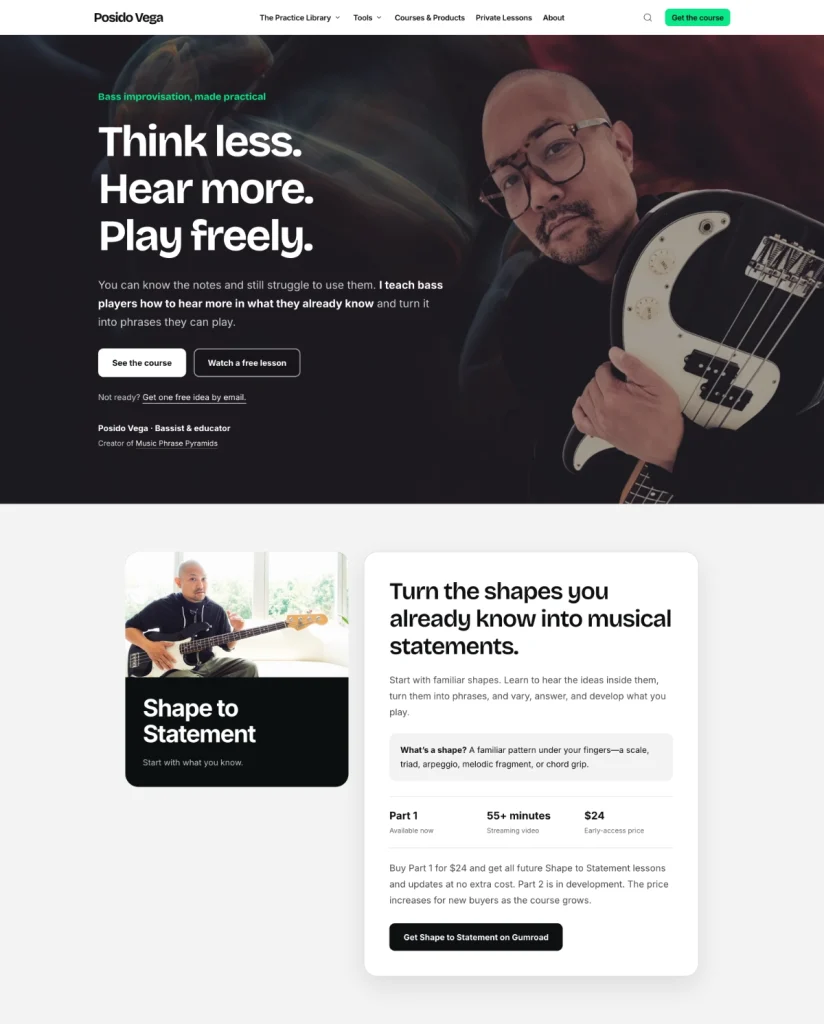
I built an education platform that gives musicians several ways to explore an idea and put it into practice:
- More than 100 free articles exploring bass playing, musical vocabulary, and practice.
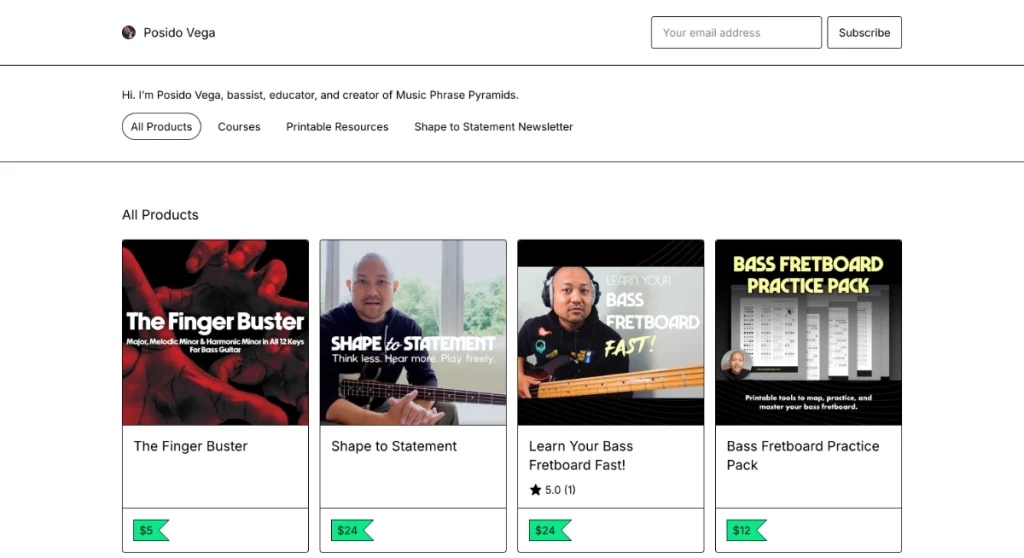
- Two paid courses covering melodic improvisation and fretboard knowledge.
- Downloadable reference maps, practice sheets, and exercises.
- Free web tools that support individual practice sessions.
- A free downloadable resource used to introduce readers to my work and grow the mailing list.
I create and teach the course material myself. The platform brings together my experience as a musician and educator with content strategy, digital production, and technical implementation.
The problem: Knowing something without being able to use it
My teaching focuses on musicians who have accumulated knowledge but find it difficult to access while playing.
They may understand a scale or chord on paper yet struggle to turn it into a melodic statement. Some have played bass for years but still hesitate when locating notes on the fretboard.
I wanted to make those problems approachable through concrete demonstrations and specific things to practice.
Simple shapes became a foundation for that work. They give students something manageable to hear, recognize, and manipulate as they develop their musical vocabulary.
Organizing the platform around learning needs
The website needed to help visitors find a useful starting point among a growing collection of resources.
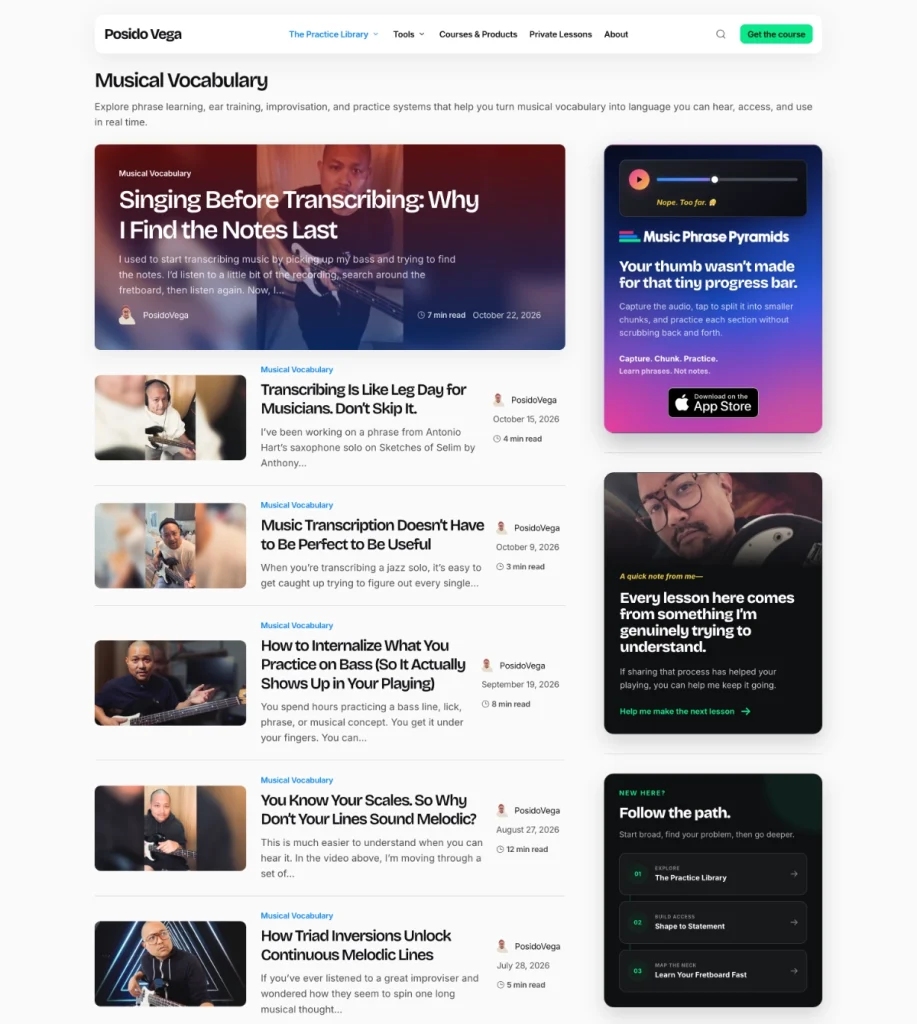
I organized the learning path around three destinations:
| Destination | Purpose |
|---|---|
| The Practice Library | Explore concepts, find inspiration, and discover ideas to practice. |
| Shape to Statement | Develop access to sounds and use familiar shapes to create melodic statements. |
| Learn Your Fretboard Fast | Build note knowledge for players who still struggle to navigate the bass fretboard. |
These provide different entry points depending on what the musician needs.
Free articles let readers explore my approach. Paid courses provide a structured foundation, while downloads and web tools support the practice that follows.
Designing a course students could follow independently
Turn a personal method into a sequence of lessons
Learn Your Bass Fretboard Fast teaches the system I used to learn the notes of my fretboard in less than two weeks.
That timeframe describes my own experience. The course gives students the method and practice sequence without promising that everyone will progress at the same speed.
I organized it into 11 step-by-step streaming videos. Each lesson shows students what to practice for that day, giving them a concrete task to return to with their instrument.
Supporting materials include:
- Fretboard maps for 4-, 5-, and 6-string basses.
- Large-format 11 × 17-inch reference PDFs.
- Letter-size fill-in-the-blank practice maps.
- Blank fretboard sheets for additional practice.
The videos explain and demonstrate the method. The printable resources give students something they can use away from the screen.
Teach in a consistent personal voice
I recorded the teaching without a script because I know the subject deeply and wanted the delivery to feel consistent with my articles and social media content.
The course still followed a planned sequence. Teaching without a script let me explain and demonstrate the material in my own words while working through that structure.
I edited the videos in Final Cut Pro and created the supporting visual resources in Affinity Designer and Affinity Publisher.
Refining the materials after feedback
Feedback helped me see how the fretboard maps could better serve players using different instruments.
I consolidated the 4-, 5-, and 6-string maps onto a single page. I also produced an 11 × 17-inch version so students could use a larger reference during practice.
These changes addressed how the material was being used. The teaching method stayed consistent, while the format became more adaptable to different basses and practice setups.
That experience reinforced the value of treating supporting resources as part of the instruction. A useful explanation also needs a format students can comfortably work with.
Building tools for the practice session
Articles and courses explain an approach, but students also need ways to organize what they do with it.
I developed free web tools with AI assistance to support that part of the process.
The Sound & Shape Practice Tracker helps musicians record the shape they are working on and the directions they have practiced. It includes separate ratings for familiarity with the sound and technical fluidity, along with space to draw the shape and write session notes.
The tracker reflects a distinction in my teaching: being able to move through a shape physically and knowing how it sounds are related skills that deserve individual attention.
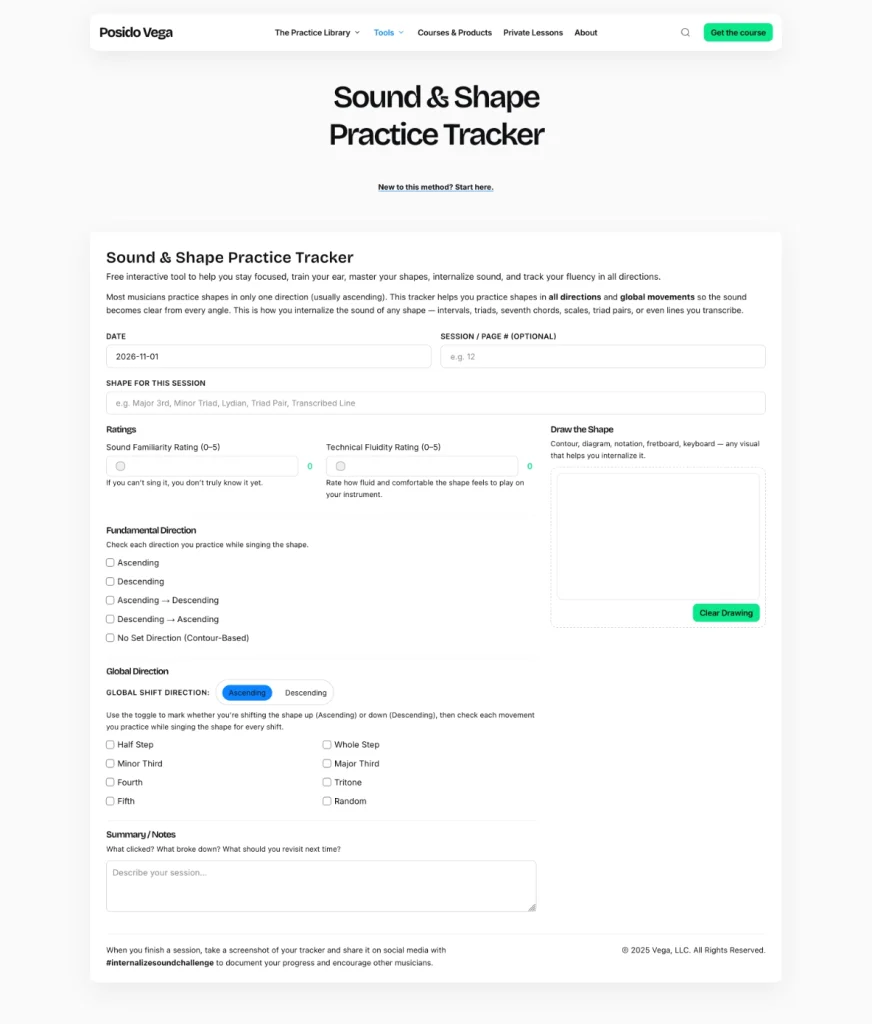
I tested the tracker in desktop and mobile browsers.
Creating content from my own teaching experience
My articles begin as free-form writing.
I work through an idea in my own words, drawing on my playing, teaching, and practice. After that first draft, I use Custom GPTs I created to help organize the article, improve skimmability, and refine its SEO elements.
The teaching perspective and initial writing come from me. AI supports the editing and presentation process.
This lets me preserve the exploratory quality of the first draft while giving readers clearer headings, shorter sections, and a more navigable article.
Connecting content strategy and SEO
I handle the topic research, article organization, and internal linking strategy myself.
That work includes deciding which questions deserve a full article, grouping related material, and connecting individual lessons to relevant courses, tools, and resources.
I also use my Custom GPTs to assist with metadata, structured data, and website performance improvements.
For this case study, I’m describing the work performed rather than claiming a measured increase in rankings or traffic. The practical goal is to make the material easier to discover and help readers find a useful next step once they arrive.
Learner feedback
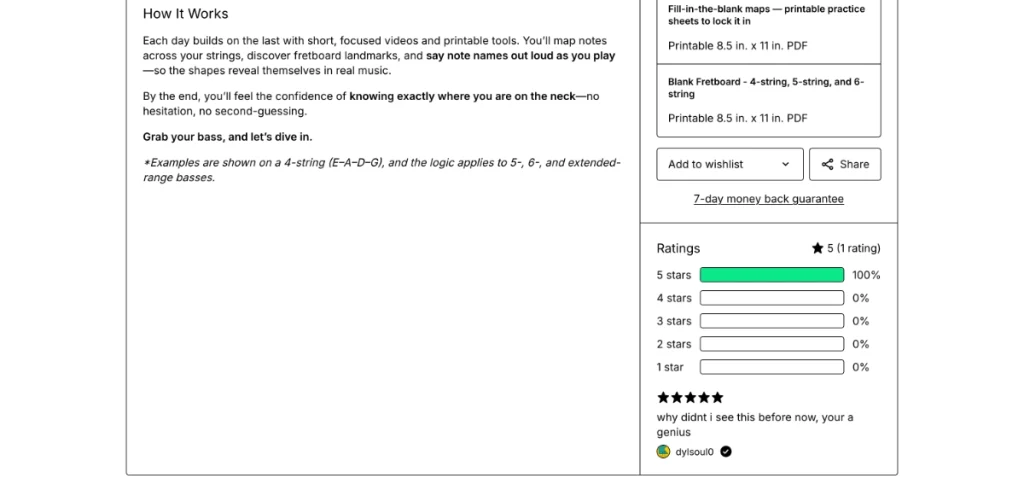
One Gumroad reviewer gave Learn Your Bass Fretboard Fast a five-star rating and wrote:
“why didnt i see this before now, your a genius”
This is one learner’s positive response. It provides feedback on the course, rather than evidence that every student will achieve a particular result or timeline.
The more actionable feedback also informed the printable-map revisions: supporting different string configurations and offering a larger format for practice.
Tools and production
| Tool or platform | Purpose |
|---|---|
| WordPress | Publishing articles, organizing learning resources, and managing the website |
| Gumroad | Selling and delivering courses and downloadable materials |
| Final Cut Pro | Editing instructional videos |
| Affinity Designer | Creating single-page visual resources |
| Affinity Publisher | Producing multi-page downloadable materials |
| Custom GPTs in ChatGPT | Assisting with article structure, SEO refinement, and technical website work |
| AI-assisted development | Supporting implementation of interactive musician tools |
Outcome and what I learned
The platform brings my teaching into formats people can use independently: articles for exploration, courses for structured instruction, printables for reference, and tools for practice.
The work goes beyond producing individual lessons. I have to decide how each resource connects to the others, how much structure a student needs, and what they should be able to do after watching or reading.
Feedback on the fretboard maps showed how a relatively small format change could make a resource more useful across instruments and practice environments.
The continuing challenge is to keep that collection coherent as it grows: helping a musician find an idea, understand it, and bring it into their next practice session.
View the full Posido Vega homepage.