
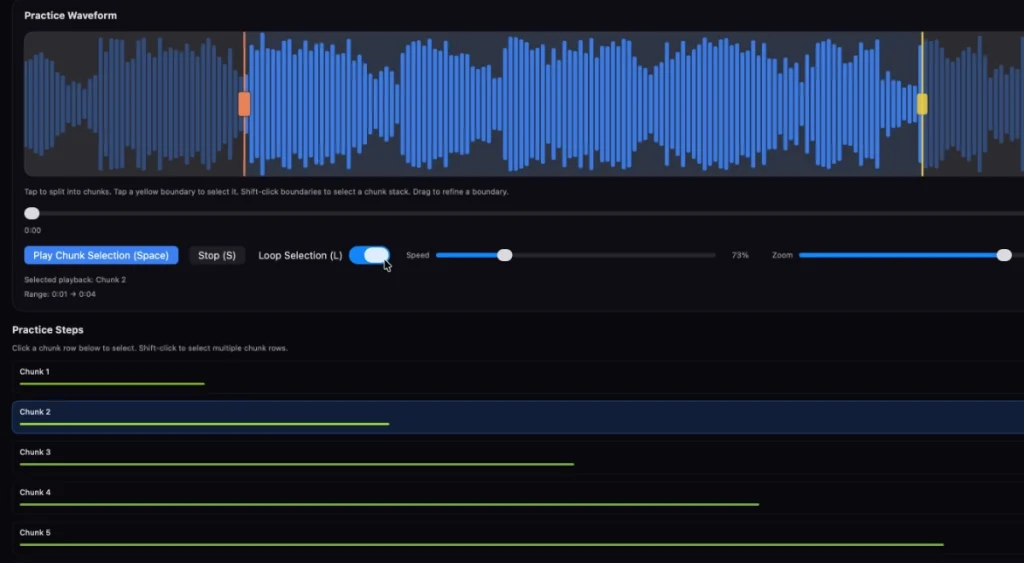
Learning a musical phrase and making it part of your playing are different challenges. A musician can spend hours figuring out the notes, then struggle to recall or use the phrase later.
I conceived Music Phrase Pyramids to help musicians capture audio and practice phrases in progressively larger chunks. The idea grew out of teaching my daughter to read, then developed through interface design, AI-assisted development, and manual testing across iPhone, iPad, and Mac.
Project: Independent project
Released
My role: Product concept, UI and workflow design, feature decisions, competitor research, manual QA across iPhone, iPad, and Mac, documentation, demo videos, and marketing website.
Implementation: AI-assisted development using Claude Code.
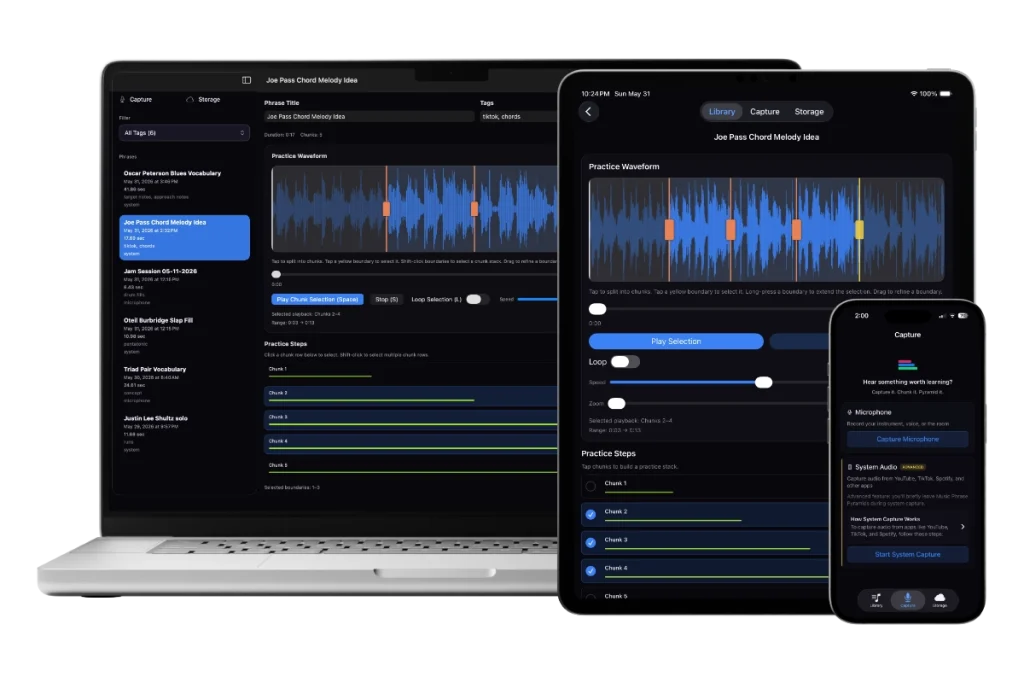
Delivered at a glance
Music Phrase Pyramids was released on the Apple App Store for iPhone, iPad, and Mac.
The app brings audio capture, waveform selection, progressive chunk practice, looping, playback speed controls, and an iCloud-connected phrase library into one workflow.
The release demonstrates a working product. Its effect on musical learning and retention has not been formally measured.
The idea: From sentence pyramids to musical phrases
I taught my daughter to read at the age of four using sentence pyramids. Each line introduced a little more of a sentence while repeating what came before:
A
A + B
A + B + C
As we practiced, I noticed that she began grasping sentence structure without me explicitly explaining grammar. She remembered how words sounded, recognized words we had read earlier when we were out together, and started telling more structured stories.
Those observations made me think about musical fluency. Could a similar approach help a musician become more familiar with a phrase by practicing small pieces and progressively joining them together?
That question became the starting point for Music Phrase Pyramids. My daughter’s experience inspired the concept; it was not evidence that an app would produce the same results in music.
The problem: Getting from transcription to usable vocabulary
As a musician and educator, I was interested in what happens after someone works out the notes of a phrase.
Knowing the notes does not necessarily mean the phrase is easy to hear internally, recall, or bring into your playing. I wanted to create a practice tool that supported spending time with the sound and structure of a phrase.
The surrounding workflow mattered too. Capturing audio, finding an exact section, and repeatedly adjusting playback controls can interrupt practice. My goal was to bring those tasks together so a musician could move from hearing something worth learning to working with it.
The workflow: Capture, divide, and build
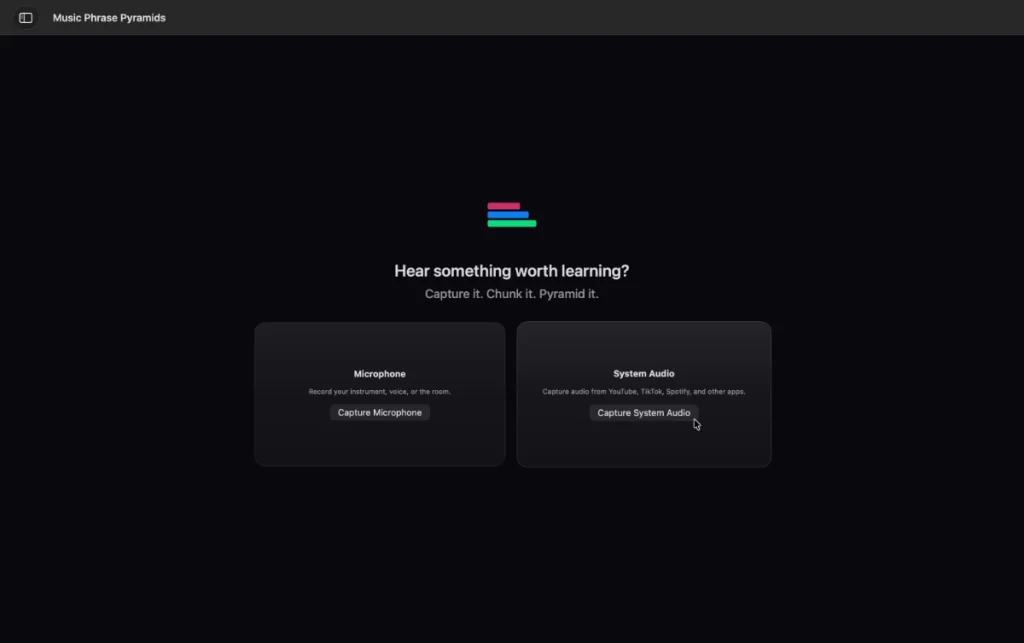
1. Capture audio for practice
The workflow starts with capturing audio on an iPhone, iPad, or Mac.
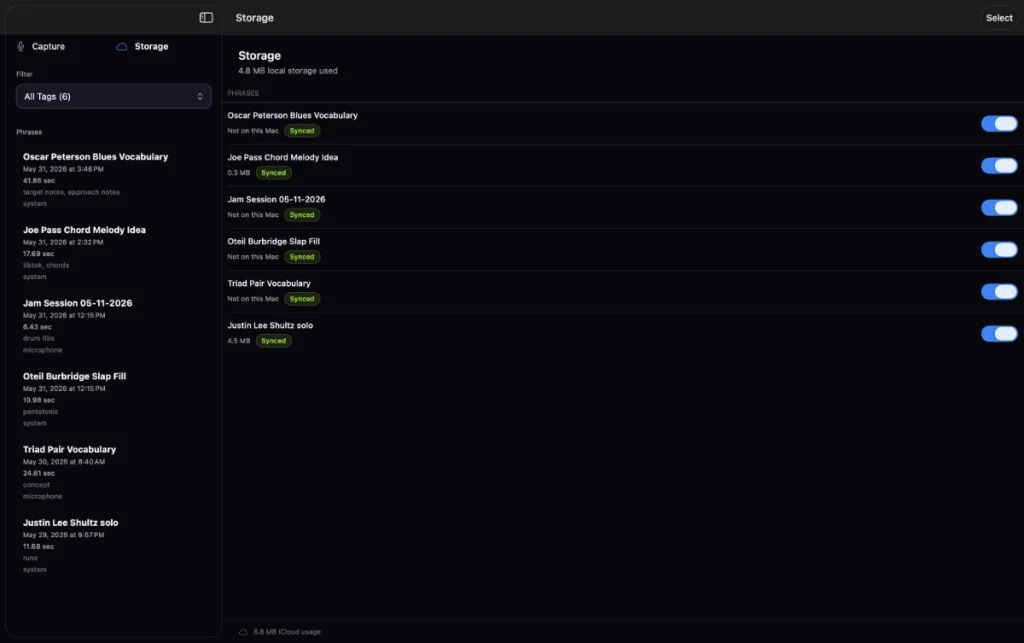
I wanted musicians to be able to bring material into their practice library from a wide range of sources, then access it across their devices through iCloud. That made cross-device availability part of the product concept and an important area of testing.
2. Select a phrase and divide it into chunks
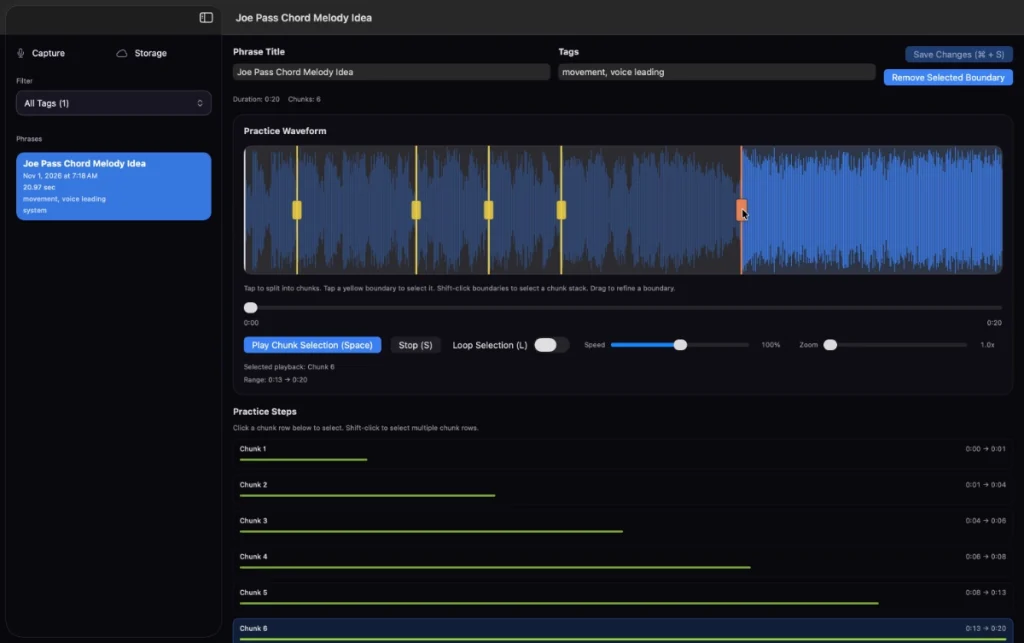
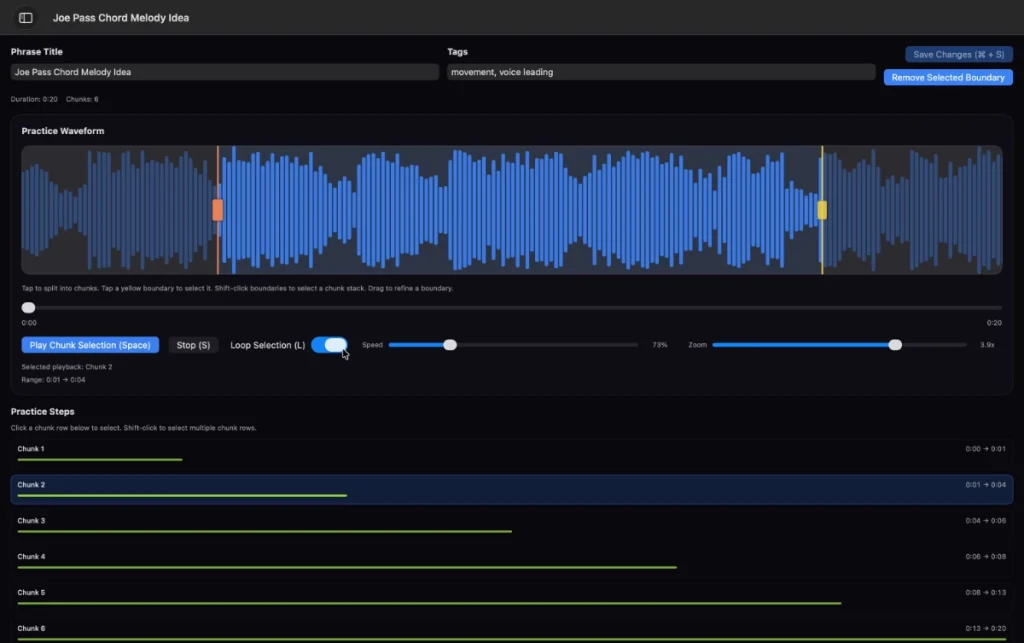
Once audio is available, the musician uses the waveform to select material and create chunks.
Selection needed to be accurate enough for short musical details. I tested chunk boundaries at different waveform zoom levels, checking that the audio played matched the section selected on screen.
3. Practice progressively larger sections
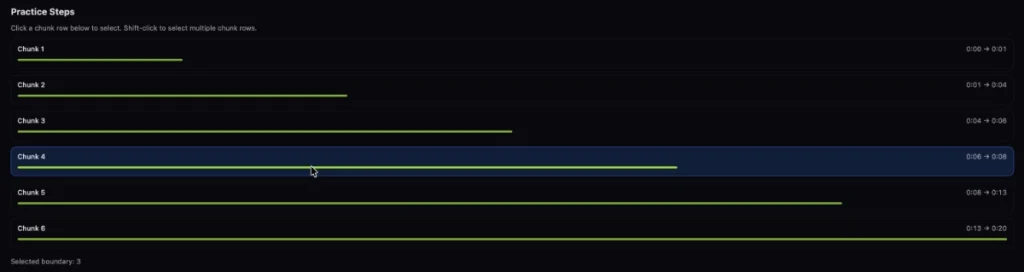
The pyramid organizes practice around progressively larger combinations of those chunks.
A musician can work with a small section, then return to it as part of a longer phrase. Looping and speed controls support that process, while moving between steps lets the musician revisit sections without repeatedly rebuilding a selection.
The app gives the sentence-pyramid idea a musical form: practice a piece, then hear and play it within an expanding context.
4. Adjust playback without rebuilding the practice setup
Musicians can slow the audio, loop a section, and move between chunks as they practice.
I included these controls within the same workflow so the musician could adjust the practice task without continually returning to a separate editing process.
A design tradeoff: Readable steps instead of proportional durations
An earlier version sized each pyramid step in proportion to its audio duration.
That was visually accurate, but it created a usability problem. A very short chunk produced a very small step. As more chunks were added, parts of the pyramid could become difficult to read and interact with.
I changed the design so each step received an equal share of the display space.
The revised pyramid no longer represented duration through the size of each step, but it provided a more consistent interface. Short chunks remained visible, and the appearance was more predictable as the musician built a phrase.
This decision prioritized the pyramid’s role as a practice control over its role as a proportional diagram.
Testing: Follow the phrase across devices and through its lifecycle
I manually tested the app on iPhone, iPad, and Mac, covering both individual features and the workflow connecting them.
Cross-device access
I captured audio on one device, then checked that it was accessible on the other two. I repeated this across combinations of iPhone, iPad, and Mac.
This helped verify the experience a musician would have when capturing something on one device and practicing it on another.
Audio and practice controls
My checks included:
- Audio quality during playback.
- Chunk selection accuracy, including when the waveform was zoomed.
- Looping and slowed playback.
- Adding, selecting, and deleting chunks.
- Moving between pyramid steps.
- The visual pyramid, interface, and overall practice workflow.
- Keyboard shortcuts.
These checks helped me evaluate whether the controls supported the intended practice task and whether the displayed selection corresponded to the audio being played.
Catching orphaned audio in iCloud
One issue appeared when testing deletion.
A phrase’s audio could be deleted from the device that captured it while the file remained in iCloud. Those orphaned files could accumulate and use storage even though the musician had removed the phrase locally.
I investigated where the files were being stored and used local deletion followed by an iCloud check to examine the behavior.
After the fix was applied, I repeated the process: delete locally, allow time for synchronization, and confirm that the associated audio was also removed from iCloud.
That test extended beyond whether a phrase disappeared from the app’s library. I checked whether its underlying file had actually been removed.
Tools and implementation
| Tool / technology | Purpose |
|---|---|
| Swift | Native Apple application development |
| CloudKit | iCloud synchronization for phrase data and audio |
| Claude Code | AI-assisted development |
| WordPress | Marketing website and product information |
I directed the product concept, workflow, interface decisions, and testing. Development was AI-assisted, and I used manual checks on the target devices to evaluate behavior and verify fixes.
Release and supporting materials
I released Music Phrase Pyramids on the Apple App Store for iPhone, iPad, and Mac.
Alongside the app, I created documentation, demonstration videos, screenshots, product copy, and a WordPress marketing website to explain the workflow and help people get started.
I also completed trademark registration for Music Phrase Pyramids.
Outcome and what I learned
Music Phrase Pyramids turned an observation from teaching my daughter into a released music practice tool.
The project required decisions beyond the initial concept. Proportional pyramid steps looked accurate but made small chunks harder to use. Cross-device access introduced a need to test synchronization and deletion, including files that were no longer visible in the local library.
Those experiences reinforced the value of testing the complete workflow: how someone brings material in, practices it, accesses it elsewhere, and eventually removes it.
The app’s learning and retention benefits remain unmeasured. What I can demonstrate is a released product, the reasoning behind its practice workflow, and specific design and testing decisions that shaped its behavior.
Explore Music Phrase Pyramids →
View the full Music Phrase Pyramids marketing homepage.
